



California legislation has redefined the potential of residential land. To maximize your property’s value, it is essential to understand the structural and legal distinctions between an Accessory Dwelling Unit (ADU) and a Junior Accessory Dwelling Unit (JADU).
An ADU, commonly known as a "granny flat" or "casita," is a secondary housing unit on a residential lot that provides independent living facilities for one or more persons.
Independence
It must include permanent provisions for living, sleeping, eating, cooking, and sanitation.

Types
Detached: A stand-alone structure (often in the backyard).
Attached: Built as an addition to the primary residence.
Conversion: Transforming existing space, such as a detached garage or a basement, into a living suite.

Size limits
Generally, allows for up to 1,200 square feet, depending on local jurisdiction and lot size.

Defining the JADU (Junior Accessory Dwelling Unit)
A JADU is a more intimate version of an ADU, created entirely within the walls of an existing or proposed single-family residence.
Size Constraint
Limited to a maximum of 500 square feet.

Efficiency Kitchen
Requires an "efficiency kitchen" (sink, appliances, and counter space), but does not necessarily require the heavy venting of a full-scale kitchen.
Shared Facilities
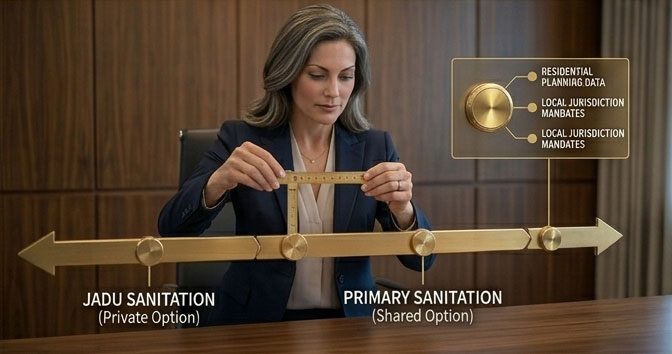
A JADU may include its own bathroom or may share sanitation facilities with the primary residence.
Owner Occupancy
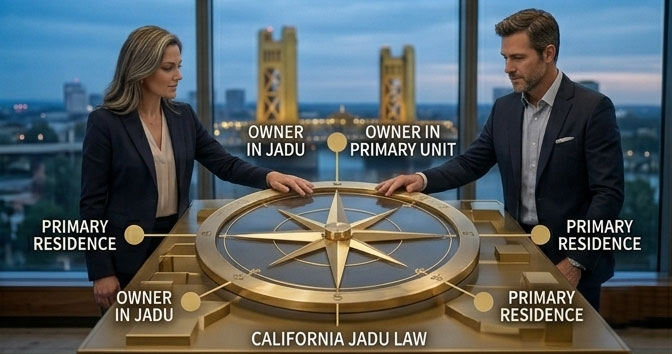
Unlike standard ADUs, California law often requires the owner to reside in either the JADU or the primary unit (though laws continue to evolve; check local mandates).

Comparative Analysis: A Strategic Overview
The Power of "The Triple Play"
For the sophisticated investor, the current California "Triple Play" strategy is the pinnacle of property optimization. Under specific conditions, homeowners can now add both one full ADU and one JADU to a single-family lot.
The Result:
A single-family property effectively becomes a triplex, tripling your potential rental streams while maintaining the tax benefits and financing options of a residential property.
Regulatory Compliance & Strategy
Navigating the differences between an ADU and a JADU requires a deep understanding of:
Title 24 Energy Standards: Meeting California's rigorous green building codes.
Setback Requirements: Navigating the 4-foot side and rear yard mandates.
Utility Metering: Deciding between sub-metering or shared utilities based on long-term ROI.